

Potter-Elvehjem Tissue Grinder vs. PRO Scientific Rotor-Stator Homogenizer
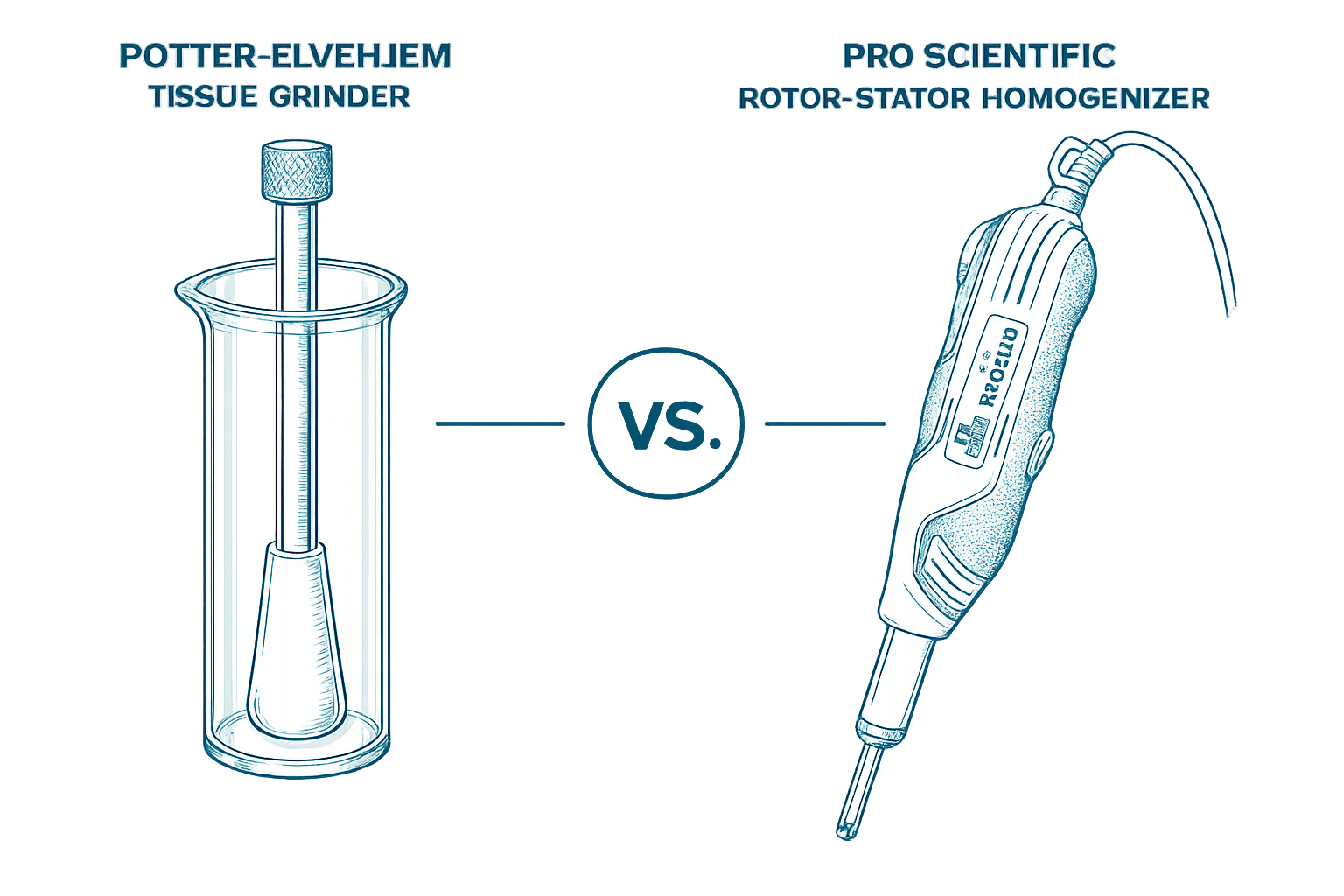
A Potter-Elvehjem tissue grinder uses a PTFE pestle inside a glass grinding chamber to process soft-tissue samples. A rotor-stator homogenizer uses a high-speed rotating rotor inside a stationary stator to create mechanical and hydraulic shear. Potter-Elvehjem grinders are useful for gentle, traditional tissue-processing protocols, while PRO Scientific rotor-stator homogenizers provide faster processing, improved repeatability, reduced operator dependence, and greater flexibility across different samples and volumes.
What Is the Difference Between These Homogenization Methods?
A Potter-Elvehjem tissue grinder, sometimes called a Potter-Elvehjem homogenizer, consists of a glass grinding chamber and a closely fitted PTFE pestle. As the pestle rotates and moves through the chamber, the sample and buffer are forced through the space between the pestle and the chamber wall.
The effectiveness of a Potter-Elvehjem tissue grinder can depend on the operator’s technique, including the applied pressure, rotation speed, number of passes, processing time, and pestle clearance.
A PRO Scientific rotor-stator homogenizer uses a high-speed rotor that turns inside a stationary stator. The sample is drawn into the generator probe and repeatedly forced through the openings of the rotor-stator assembly.
This process creates mechanical and hydraulic shear that efficiently reduces particle size, disrupts tissue, mixes samples, and produces a more uniform homogenate. When the appropriate homogenizer and generator probe are selected, many samples can be processed in approximately 10–30 seconds.
Key Differences at a Glance
| Feature | Potter-Elvehjem Tissue Grinder | PRO Scientific Rotor-Stator Homogenizer |
|---|---|---|
| Operating Method | Manual or motor-assisted pestle grinding | High-speed rotor-stator processing |
| Primary Mechanism | Compression and grinding between a pestle and glass chamber | Mechanical and hydraulic shear |
| Processing Speed | Generally slower and more operator dependent | Many samples can be processed in approximately 10–30 seconds |
| Repeatability | Can vary with operator technique | More consistent and repeatable processing |
| Operator Effort | Requires more manual handling | Motorized operation reduces manual effort |
| Sample Types | Primarily soft tissues and established grinding protocols | Tissues, cells, emulsions, suspensions, food products, cosmetics, pharmaceuticals, and more |
| Processing Options | Fixed pestle and chamber combinations | Interchangeable generator probes for different sample volumes and applications |
| Throughput | Best suited for a limited number of samples | Suitable for individual samples and higher-throughput workflows |
| Best Suited For | Gentle, traditional, low-throughput tissue-processing procedures | Fast, flexible, and repeatable laboratory sample preparation |
When Should You Choose a Potter-Elvehjem Tissue Grinder?
A Potter-Elvehjem tissue grinder may be appropriate when:
- An established laboratory protocol specifically requires a Potter-Elvehjem grinder.
- You are processing a limited number of small, soft-tissue samples.
- You require a gentle, traditional grinding method.
- Processing speed and throughput are not primary concerns.
- Your procedure has been validated using a specific pestle and chamber combination.
When Should You Choose a PRO Scientific Homogenizer?
A PRO Scientific rotor-stator homogenizer may be the better choice when:
- You need faster sample processing.
- You want more consistent and repeatable results.
- Multiple operators will be processing samples.
- You want to reduce operator-dependent variation.
- You process different sample types or sample volumes.
- You need interchangeable generator probes.
- You require greater flexibility for future applications.
- You need to improve laboratory throughput.
Why Choose a PRO Scientific Rotor-Stator Homogenizer?
- Fast sample processing with less manual effort
- More consistent and repeatable results
- Reduced dependence on operator technique
- Interchangeable generator probes for different applications
- Options for microliter samples through larger laboratory volumes
- Suitable for tissues, cells, emulsions, suspensions, food products, cosmetics, and other materials
- Hand-held, digital, benchtop, and multi-sample systems available
- Technical assistance for homogenizer and generator probe selection
Because rotor-stator homogenization can be completed quickly, prolonged sample exposure and heat buildup can often be minimized. Temperature-sensitive samples may also be processed while the vessel is held in an ice bath or cooling bead bath.
Not Sure Which Homogenization Method Is Right for Your Application?
PRO Scientific can help select a homogenizer and generator probe based on your sample type, volume, vessel size, viscosity, and desired processing results.
Can a PRO Scientific Homogenizer Process Soft Tissue?
Yes. PRO Scientific rotor-stator homogenizers can process many soft tissues, including liver, brain, kidney, muscle, and tumor samples. Laboratories are not limited to using a Potter-Elvehjem tissue grinder for soft-tissue homogenization.
The appropriate setup depends on the sample volume, tissue type, vessel size, desired particle size, and required level of shear. Selecting the correct generator probe is important for achieving efficient and repeatable processing.
For assistance selecting a system, review the Laboratory Homogenizer Selection Guide or browse PRO Scientific generator probes .
Published Examples of Soft-Tissue Homogenization
The following published studies used the Bio-Gen PRO200 Homogenizer for soft-tissue sample preparation:
- Fatty liver – PRO200 Homogenizer
- Rat liver – PRO200 Homogenizer
- Liver – PRO200 Homogenizer
- Equine liver – PRO200 Homogenizer
- Mouse liver – PRO200 Homogenizer
- Kidney – PRO200 Homogenizer
- Renal tumor – PRO200 Homogenizer
- Hippocampi – PRO200 Homogenizer
- Thalamus – PRO200 Homogenizer
Frequently Asked Questions
What is a Potter-Elvehjem tissue grinder?
A Potter-Elvehjem tissue grinder is a laboratory homogenization device that uses a closely fitted PTFE pestle inside a glass grinding chamber. The pestle is moved and rotated to grind and disrupt soft-tissue samples.
What is a rotor-stator homogenizer?
A rotor-stator homogenizer uses a high-speed rotating rotor inside a stationary stator. The sample is drawn into the generator probe and forced through the rotor-stator openings, creating mechanical and hydraulic shear.
Can a rotor-stator homogenizer replace a Potter-Elvehjem grinder?
In many tissue-processing applications, a rotor-stator homogenizer can provide faster and more repeatable processing than a Potter-Elvehjem grinder. However, laboratories should continue using a Potter-Elvehjem grinder when it is specifically required by a validated protocol.
Which homogenizer is better for soft tissue?
Both methods can process soft tissue. A Potter-Elvehjem grinder may be preferred for gentle manual processing, while a rotor-stator homogenizer is generally better when speed, repeatability, and reduced operator dependence are priorities.
Which homogenizer is faster?
A rotor-stator homogenizer is generally faster. With the appropriate generator probe, many samples can be processed in approximately 10–30 seconds.
Does rotor-stator homogenization create heat?
Some heat can be produced during mechanical homogenization. Because rotor-stator processing is typically completed quickly, heat exposure can often be minimized. Temperature-sensitive samples may also be processed in an ice bath or cooling bead bath.
How do I select the correct generator probe?
Generator probe selection depends on the sample type, sample volume, vessel dimensions, desired particle size, viscosity, and required level of shear. PRO Scientific can assist with selecting the appropriate homogenizer and generator probe.
Which Homogenization Method Should You Choose?
Choose a Potter-Elvehjem tissue grinder when an established procedure requires gentle manual grinding or when you are processing a limited number of small, soft-tissue samples.
Choose a PRO Scientific rotor-stator homogenizer when you need faster processing, improved repeatability, reduced operator effort, interchangeable generator probes, or greater flexibility across different sample types and volumes.
Need Help Selecting a Homogenizer?
PRO Scientific can help identify the appropriate homogenizer and generator probe for your sample, volume, vessel, and processing requirements.
